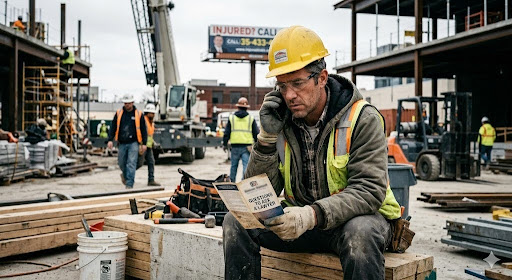
Before You Hire the Name You Recognize, Ask These Questions
Most people I talk to after a construction accident have already made one mistake before they call me. They signed with the first firm that called them back.
I understand why. You’re in pain, you’re worried about money, and some attorney’s face you’ve seen on a billboard a hundred times is suddenly on your phone offering to help. That feels like relief. But here’s what I’ve watched happen too many times: a worker with a legitimate third-party claim—one that could have been worth real money against a negligent subcontractor or equipment manufacturer—ends up with a workers’ comp settlement that doesn’t touch pain and suffering, future lost wages, or the full cost of long-term care. Not because the law didn’t allow for more. Because the lawyer they hired didn’t know how to look for it.
Slow down. The decision you make in the next few days matters more than the speed with which you make it.
What a Construction Accident Case Actually Requires
A construction site isn’t a parking lot slip-and-fall.
It’s a layered environment with general contractors, subcontractors, equipment rental companies, property owners, and sometimes government entities—all of whom may carry some share of liability. Workers’ compensation covers your medical bills and a portion of lost wages. It does not compensate you for pain and suffering, and it doesn’t account for the full scope of what a serious injury costs a family over years.
A lawyer who only files workers’ comp claims is not the same as a personal injury lawyer massachusetts who understands how to identify third-party defendants and build a parallel civil case. Both types of representation can matter in the same claim. The question is whether your attorney knows the difference—and whether they’re actively looking for every liable party or just the fastest path to a check.
When I screen a case, the first thing I want to know isn’t the injury. It’s who else was on that site. Who owned the scaffolding? Who was responsible for the safety plan? Was there an OSHA inspection after the incident, and what did it find? Those answers shape whether a case is worth $40,000 or $400,000.
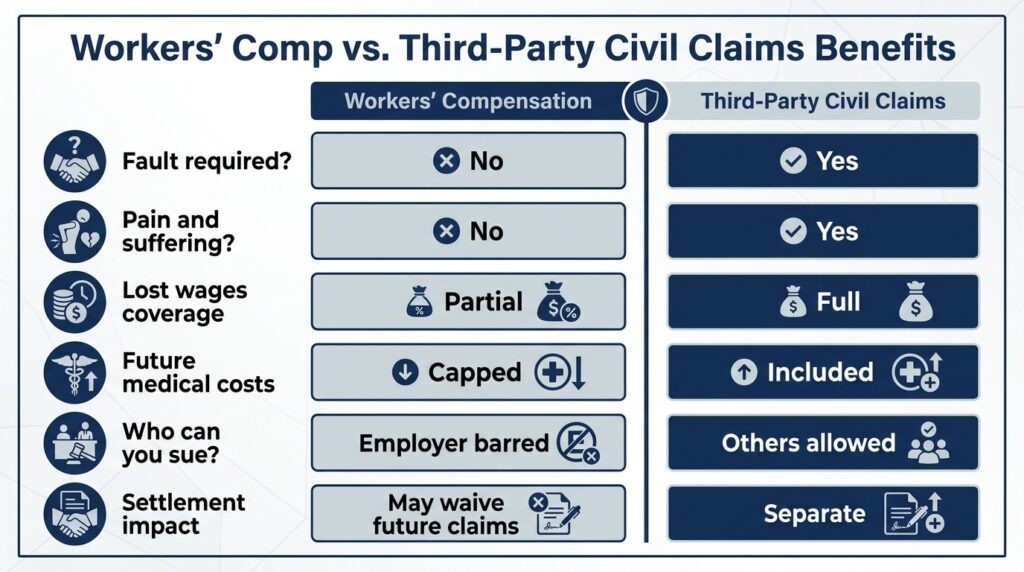
Workers’ Comp vs. Third-Party Claims: Why This Distinction Can Change Everything
This is where I see the most damage done to injured workers—so before we get to interview questions, it’s worth understanding exactly what’s at stake.
| Workers’ Compensation | Third-Party Civil Claim | |
|---|---|---|
| Fault required? | No — no-fault system | Yes — must prove negligence |
| Pain and suffering? | Not covered | Fully recoverable |
| Lost wages | Partial replacement only | Full recovery possible |
| Future medical costs | Often capped or disputed | Included in damages |
| Who can you sue? | Cannot sue your employer | Subcontractors, manufacturers, property owners |
| Settlement impact | May waive future employer claims | Separate from workers’ comp |
Workers’ compensation sounds straightforward, and it is—as far as it goes. You don’t have to prove your employer was negligent. But the benefits are capped, permanent disability is often undervalued, and accepting a settlement frequently means signing away future claims against your employer.
A third-party personal injury claim operates entirely outside that system. If a subcontractor left a hazard, an equipment manufacturer’s product failed, or a property owner ignored unsafe conditions, you may have a civil claim that includes pain and suffering, full lost wages, and future medical costs. Identifying those third parties requires investigation—someone who knows construction site hierarchy, reads contracts, and understands how liability gets allocated between a general contractor and their subs.
A lawyer who only files workers’ comp claims will never find that case.
The Questions That Separate Real Construction Lawyers from Volume Firms
So how do you actually tell the difference before you sign anything? Here’s what I’d ask—and what the answers should sound like.
“How many construction accident cases have you handled in the last three years, and did you take any of them to trial?”
This is the most important question you can ask. A lawyer who handles construction cases regularly will answer with specifics—scaffold collapses, trench failures, crane accidents, falls from elevation. They’ll tell you whether they’ve deposed OSHA compliance officers or retained safety experts. If they get vague or pivot to general personal injury statistics, that’s your answer.
The trial record question matters for a reason that isn’t obvious at first. Insurance companies and defense firms keep records on opposing counsel. They know which lawyers actually go to trial and which ones always settle. A lawyer with a credible trial record gets better settlement offers because the other side knows the threat is real.
“Who will actually handle my case day to day?”
Big firms sign clients at the partner level and hand them to junior associates or paralegals. I’ve seen families go months without speaking to the attorney whose name is on the door. Ask explicitly: will you be my primary contact, or will I be working with someone else? Working directly with an experienced attorney from the start consistently produces better outcomes—not because junior staff are incompetent, but because construction cases require judgment calls that come from experience, not checklists.
“What does your contingency fee cover, and what costs am I responsible for?”
Every firm says “no fee unless we win.” That’s not the whole picture.
The contingency fee percentage—typically 33% pre-litigation, sometimes higher if the case goes to trial—is only part of the equation. Case expenses like expert witnesses, OSHA record requests, deposition transcripts, and accident reconstruction can run into tens of thousands of dollars. Some firms advance those costs and deduct them from your recovery. Others require you to pay as you go. You need to know which model you’re dealing with, and you need it in writing before you sign.
“Have you reviewed OSHA records for cases like mine, and do you work with safety experts?”
If OSHA cited your employer or a subcontractor for a safety violation related to your accident, that citation doesn’t automatically win your case — but an official OSHA report documenting safety failures provides a strong foundation for proving negligence, and the legal doctrine of negligence per se may allow a violation to function as direct proof of a breach of duty. A lawyer who doesn’t know how to obtain and use those records is leaving tools on the table. A lawyer who doesn’t know how to obtain and use those records, or who doesn’t have relationships with construction safety experts, is leaving tools on the table.
“But Every Firm Says the Same Things”
Fair point. Every firm’s website says they’re experienced, aggressive, and dedicated to maximum recovery. Here’s how to cut through that.
Read testimonials for specifics, not stars. You’re not looking for five-star ratings. You’re looking for clients who mentioned the lawyer explained the process clearly, who described direct communication with the attorney rather than just staff, who noted the case went to trial or that the lawyer identified a liable party they hadn’t considered. Generic praise means less than a specific story.
Ask for references. A confident attorney with real construction experience will not hesitate. One who hedges or deflects is telling you something.
Pay attention to how the consultation goes. Were you rushed? Did the lawyer ask detailed questions about the site, the other contractors present, the equipment involved? Or did they mostly talk about how much money you might recover? The lawyer who asks hard questions in the first meeting is the one who will ask hard questions of the defense later.
Don’t underestimate local knowledge. Venue considerations can affect strategy significantly. A lawyer who knows the tendencies of local judges and juries, who has relationships with regional safety experts, and who understands how construction liability typically plays out in your county’s courts is operating with real advantages over someone who treats your case like it could be anywhere.
What the Process Should Look Like If You Hire the Right Person
A serious construction accident lawyer doesn’t wait for the insurance company to contact them.
Within the first few weeks, they should be requesting OSHA records, preserving evidence, identifying all potentially liable parties, and putting relevant insurers on notice. They should be coordinating your medical treatment to ensure your injuries are properly documented—not directing your care, but making sure nothing falls through the cracks.
You should hear from them or their team regularly. Not just when there’s a development, but proactively. The statute of limitations for personal injury claims is a hard deadline—miss it and your case is gone—so a lawyer who is actually managing your case will have a clear timeline and keep you informed about where you stand.
Here’s what that timeline typically looks like in a well-managed construction case:
- Weeks 1–2: Evidence preservation, OSHA record requests, identification of all parties on site
- Weeks 3–6: Medical documentation review, safety expert consultation, insurer notification
- Months 2–4: Investigation of third-party liability, contract review, witness interviews
- Months 4–12: Demand letters, negotiation, or litigation filing depending on case complexity
- Ongoing: Regular client communication, statute of limitations tracking, settlement evaluation
Settlement discussions, when they come, should be explained to you fully. What is the offer? What are the strengths and weaknesses of your case? What would trial look like, and what’s the realistic range of outcomes? A lawyer who pushes you toward a fast settlement without that conversation is prioritizing their fee over your outcome.
Before You Sign Anything
Ask the questions above. Write them down if you have to.
A lawyer who gets impatient with them is not the lawyer you want. A lawyer who answers them with specifics, who explains their process, who tells you honestly what they don’t know yet and how they’ll find out—that’s the one worth trusting with your family’s financial future.
The right firm will welcome the scrutiny. That’s how you know.